01/03The Discovery
DDD by design
I run collaborative discovery — event storming, impact mapping, example mapping — so product, business and devs share one model of the domain. Devs sit with the client; domain understanding flows back into the code.
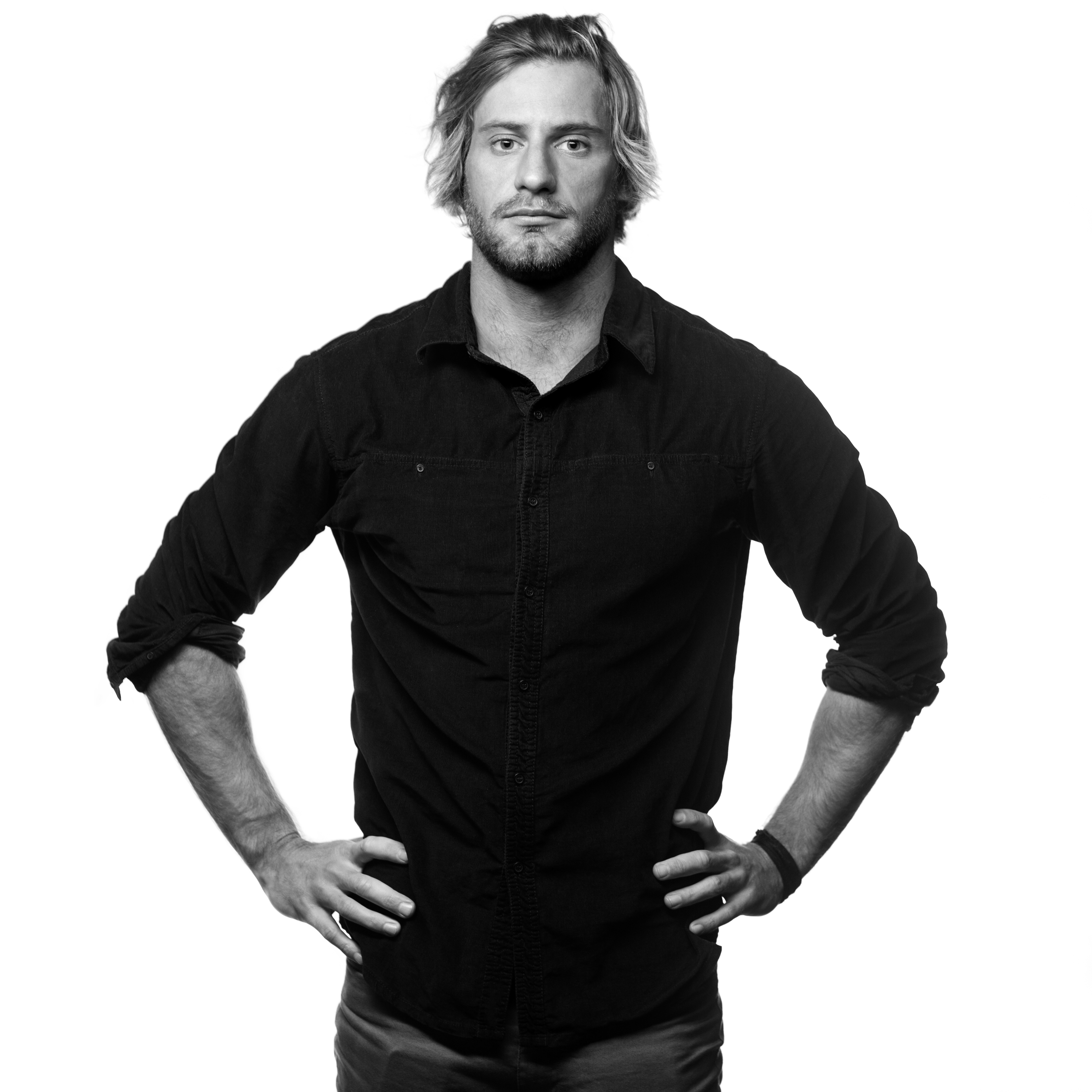
Ship what the business actually needs.
Tech lead & educator with 13+ years in the trenches. I wire strategic & tactical DDD, TDD and Clean Architecture into teams — and I design delivery pipelines where AI agents do the derivable work, so humans focus on what's scarce: business judgment.
Strategic & tactical DDD, TDD, Clean Architecture — with a product, agile and devops culture on top. My job is to close the distance between a decision and the evidence about it.
I facilitate collaborative discovery so product, business and devs share a single model of the domain — and build what has real value, not just what is feasible. Then I bring domain understanding down into the code: bounded contexts, ubiquitous language, vertical slices.
“When you can build the wrong thing 10× faster, the discipline that tells you it’s wrong becomes more valuable, not less.”
Discovery to derive the right thing. Architecture to build it so it lasts. An agentic pipeline to ship it, iteration after iteration.
I run collaborative discovery — event storming, impact mapping, example mapping — so product, business and devs share one model of the domain. Devs sit with the client; domain understanding flows back into the code.
Clean Architecture / Ports & Adapters, tactical DDD and modular monoliths with vertical slices. Event sourcing with Dynamic Consistency Boundaries: one log per bounded context, each command's consistency boundary derived from what it reads, not from a fixed aggregate. Business rules as pure deciders, specified by executable, prose-free contracts — and when an invariant moves into the type system, the check that guarded it is retired.
Business judgment is expensive and rare — everything else can be derived. I build delivery pipelines that move toward the dark factory: the pipeline is a versioned graph, agents live in the nodes that require judgment, deterministic verdicts sit on every edge. Each run's trajectory is recorded and checked; the agent never decides to commit — a green verdict does. Every rule is a ratchet with a versioned baseline, every convention change goes through an ADR, every recurring failure gets a machine signature. Code review moved upstream: what humans review is the arbitrated contract.
Tech lead on applications for industrial clients — from product framing to delivery. Driving the shift toward autonomous delivery: an agent graph produces, deterministic gates verify, humans decide. Whole bounded contexts migrated to event sourcing by autonomous night runs; skills developed eval-first; design choices stress-tested by competing agents before a human rules.
Building business apps and e-commerce with craftsmanship practices. Awwwards nomination, published in This Week In React (FR), CTO InShape podcast on frontend Clean Architecture. Clients: Castel, Vexim, Vico, Graduate Store, Magenta Skateboards…
Teaching DDD, Clean Architecture, TDD, SOLID and modern stacks in engineering schools (EFREI, Sup de Vinci, EPSI…), in-company upskilling and coding bootcamps (Wild Code School, 3W Academy…).
Led a gamified learning platform for students and staff. Ran strategic DDD workshops, domain & bounded-context modeling, and grew the team on craft/devops/agile practices with a modular monolith and CI/CD.
Built and maintained the Tick&Live ticketing platform, used by Fnac, Sud Ouest, Box Office. Started a Clean Architecture / DDD rewrite and rolled out craft best practices.
Conference talks, podcasts and publications on Clean Architecture, unit testing and AI-enhanced delivery.
Tech leadership, DDD & craft coaching, or an AI-driven delivery pipeline — if the tech needs to match what the business actually needs, let’s talk.